Sample Question
The following question and image are taken from Cambridge 19 Test 1 Writing Task 1.
Related Report: Pie Chart
Sample Answer
Word count: 198
Band Descriptor Analysis
1. Task Achievement
The report contains 198 words, exceeding the IELTS Academic Writing Task 1 minimum of 150 words. It identifies the main trends, supports them with relevant figures and groups the activities logically rather than describing every data point.
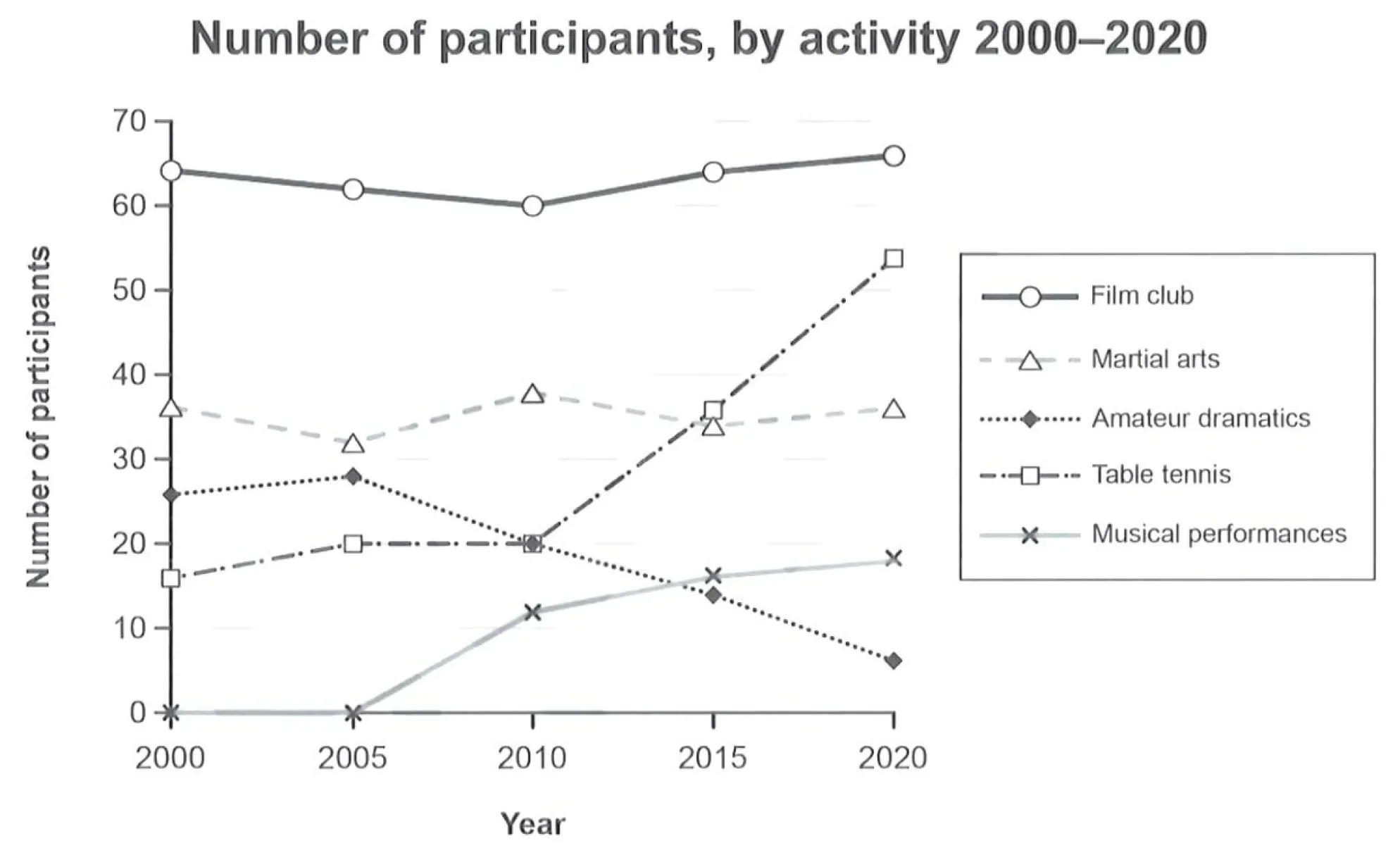
- Relatively limited overall change — film club and martial arts: Film club attendance fell before recovering to a slightly higher level, while martial arts participation fluctuated within a narrow range and ended at its initial level.
- More pronounced changes — table tennis, amateur dramatics and musical performances: This group captures the substantial rise in table tennis, the sustained decline in amateur dramatics and the later growth in musical performances.
The overview identifies the main trends, while the detail paragraphs substantiate these observations with relevant figures. The report prioritises the main trends and uses selected figures to compare changes in participation across the five activities. Meeting the word-count requirement is necessary, but does not by itself guarantee a particular band score.
2. Coherence and Cohesion
The four-paragraph structure progresses logically from the introduction and overview to two detail paragraphs organised by trend. Linking devices clarify relationships between observations:
- while / whereas — contrast trends within a sentence.
- In contrast / By contrast — highlight differences between activities.
- compared with — introduces a direct numerical comparison.
- before — connects successive stages of a trend.
- then / subsequently — establish chronological progression.
The logical grouping and progression make the report easy to follow. Effective cohesion depends on clear relationships between ideas, not on using as many linking expressions as possible.
3. Lexical Resource
The use of approximation language, such as approximately, roughly, about, around, nearly, just above, and slightly under, demonstrates lexical variety and helps describe numerical data precisely. However, these expressions should reflect the actual values shown in the graph rather than be used merely to avoid repetition.
The report uses precise vocabulary to describe trends, numerical changes and relative participation levels.
- fluctuated — describes variation within a range.
- peaked at — identifies the highest point in a series.
- declined steadily — describes a sustained downward trend.
- rose sharply — emphasises a substantial increase.
- remained relatively stable — describes limited overall change.
- the second most popular activity — expresses relative ranking.
Expressions such as participation, attendance and numbers of participants provide appropriate variation. The priority is accurate meaning and natural collocations, rather than replacing words merely to avoid repetition.
4. Grammatical Range and Accuracy
The report combines simple and complex sentences, coordinated clauses and non-finite constructions.
- Complex sentence: Overall, the film club remained the most popular activity, while table tennis experienced the largest increase in participation. The conjunction while connects two contrasting observations.
- Contrast and non-finite constructions: Film club attendance fell to around 60 in 2010 before recovering to roughly 66 in 2020, whereas participation in martial arts fluctuated between approximately 32 and 38, ending at about 36. The sentence combines contrast with concise descriptions of successive changes.
- Result construction: It then rose sharply to about 36 in 2015 and reached approximately 54 in 2020, making it the second most popular activity. The phrase making it the second most popular activity expresses the resulting ranking.
- Compound sentence: Musical performances attracted no participants in either 2000 or 2005, but participation subsequently rose to just above 10 in 2010 and nearly 20 by 2020. The conjunction but connects two independent clauses and highlights the contrast between the initial and later figures.
- Past-simple tense: Table tennis participation started at roughly 16 in 2000 and remained relatively stable at around 20 until 2010. The past simple is appropriate for describing the completed historical period.
These examples demonstrate grammatical variety used to compare trends, express sequence and summarise changes concisely. However, grammatical range and accuracy must be assessed across the complete report; complex structures alone do not guarantee a high band.