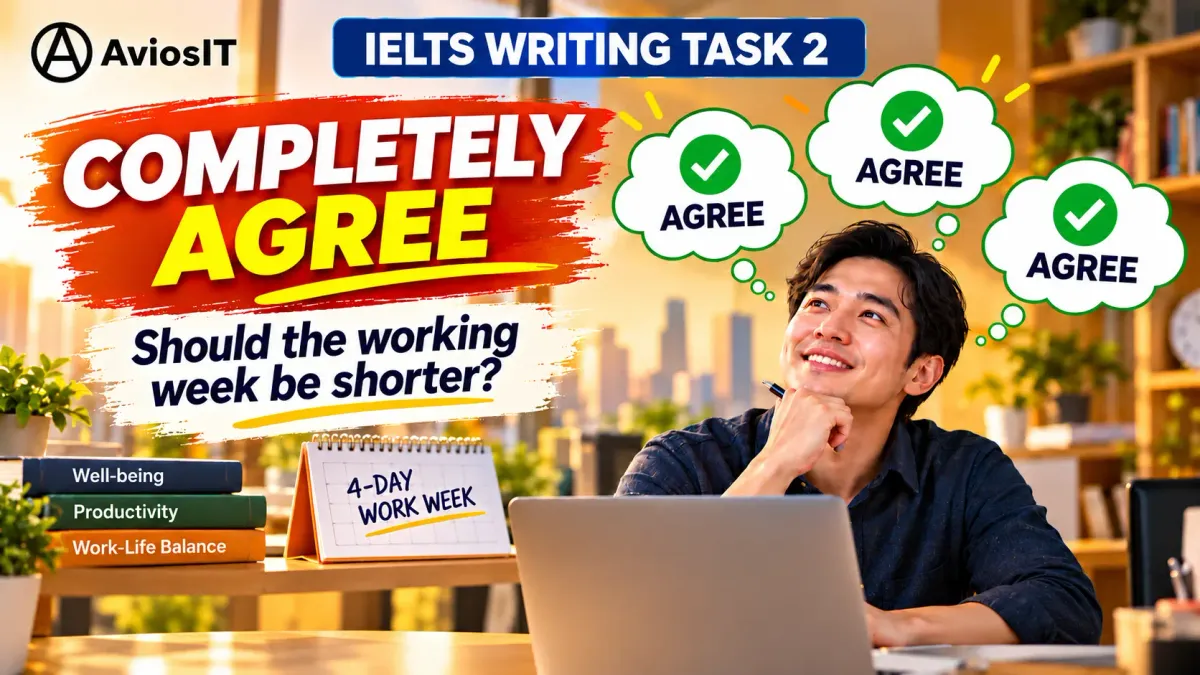
Sample Question
The following question is taken from Cambridge 19 Test 2 Writing Task 2.
Related Essay: Partially Agree or Disagree
Sample Answer
Word count: —
Related Essay: Both Views with Specific Opinion
Band Descriptor Analysis
1. Task Response
The essay directly addresses the statement and maintains a clear position of complete agreement throughout. The introduction identifies three main benefits of a shorter working week and a longer weekend: improved well-being, greater productivity and a healthier work-life balance. Each body paragraph develops one of these benefits through relevant explanations and examples.
- Physical and mental health: The first body paragraph explains how long working hours and insufficient recovery time can contribute to stress, exhaustion and burnout. It then illustrates how an additional day off could provide more time for sleep, exercise and recovery, helping workers return to work feeling refreshed.
- Productivity: The second body paragraph explains that well-rested employees may concentrate more effectively and make fewer mistakes. It also identifies ways employers could improve efficiency, including eliminating unnecessary meetings and organising tasks more effectively.
- Work-life balance: The third body paragraph explains how a longer weekend could give workers more time for family responsibilities, social activities and personal interests. The examples of caring for family members and pursuing hobbies illustrate how the additional time could benefit workers' personal lives.
The essay also acknowledges a potential difficulty: some businesses might struggle to maintain their existing output with fewer working days. Rather than ignoring this concern, the writer proposes better planning and more efficient working practices as possible ways to address it. This qualification recognises a practical limitation without changing the writer's position of complete agreement. The conclusion reinforces the original stance by summarising the benefits of a shorter working week and a longer weekend. These features demonstrate how the response addresses the task, develops relevant ideas and maintains a consistent position.
2. Coherence and Cohesion
The essay progresses logically from the introduction through three focused body paragraphs to the conclusion. Each body paragraph has a distinct purpose: the first discusses physical and mental health, the second examines productivity, and the third considers work-life balance. Within the paragraphs, explanations and examples develop the main points, while cohesive devices help clarify relationships between ideas.
- because — introduces the reasons supporting the writer's position in the introduction.
- For example and For instance — introduce examples supporting the discussion of the benefits of a shorter working week and a longer weekend.
- Admittedly — acknowledges a potential difficulty that could arise if businesses had fewer working days.
- However — introduces the proposed response to that difficulty: better planning and more efficient working practices.
- such an arrangement — refers back to the proposed shorter working week and longer weekend.
- These activities — refers to the family and personal activities described immediately before it.
These cohesive devices serve different purposes, including introducing reasons and examples, acknowledging a counterpoint, signalling contrast and maintaining reference to previously mentioned ideas. The paragraphing also separates the three main benefits, making the progression of the argument easy to follow. Overall, the organisation and use of cohesion support the clear development of the writer's position.
3. Lexical Resource
The essay uses a range of vocabulary relevant to working conditions, employee well-being, productivity and personal life. Examples taken directly from the response include:
- well-being
- enhance productivity
- work-life balance
- stress, exhaustion and burnout
- work-related stress
- maintain their existing output
- eliminating unnecessary meetings
- more efficient working practices
- pursue personal interests
- a demanding work schedule
These expressions are relevant to the essay's main arguments and help communicate ideas about health, workplace efficiency and personal responsibilities. Collocations such as enhance productivity, work-related stress and maintain their existing output express the intended meanings concisely. The essay also uses employees and workers to refer to people in employment, and employers when discussing those responsible for organising work. This variation is appropriate to the context, while repetition of central concepts such as productivity and working time remains relevant to the argument.
The wording also expresses different degrees of certainty. For example, can lead to describes a possible consequence, could give workers presents a potential benefit, and some businesses might struggle acknowledges a possible limitation. These choices avoid presenting every outcome as inevitable. British English spelling is also consistent in forms such as organising and socialise. These observations support an assessment of vocabulary choice and control without treating individual expressions as sufficient evidence of a particular band score.
4. Grammatical Range and Accuracy
The essay combines straightforward statements with more complex structures to explain reasons, describe possible outcomes, acknowledge limitations and express relationships between ideas. Examples from the response include:
- Reason clause: I completely agree with this statement because such an arrangement could improve their well-being, enhance productivity and promote a healthier work-life balance. The because clause explains the writer's position, while the three coordinated verb phrases present the proposed benefits.
- Subordinate time clause: Long working hours can lead to stress, exhaustion and burnout, particularly when employees have insufficient time to recover. The clause beginning with when describes the circumstances in which these effects may occur.
- Participle clause: For example, an extra day off could give workers more time to sleep, exercise and recover from work-related stress, helping them return to work feeling refreshed. The participle clause beginning with helping adds a possible result of the additional recovery time.
- Contrast within a complex sentence: Well-rested employees are more likely to concentrate effectively and make fewer mistakes, while employers could improve efficiency by eliminating unnecessary meetings and organising tasks more effectively. The while clause contrasts what well-rested employees are likely to achieve with how employers could improve efficiency.
- Concession and contrast: Admittedly, some businesses might struggle to maintain their existing output with fewer working days. However, better planning and more efficient working practices could help address this challenge. The first sentence acknowledges a potential difficulty, while the second presents a possible response.
- Relative clause: For instance, they could use the extra day to care for family members or participate in hobbies that are difficult to fit around a demanding work schedule. The clause beginning with that describes the hobbies being discussed.
- Modal construction in the conclusion: In conclusion, I completely agree that the working week should be shortened, as this would support workers' health, encourage greater productivity and give them more time to enjoy their personal lives. The modal verb would expresses the anticipated benefits, while the coordinated verb phrases maintain a parallel structure.
These structures allow the writer to explain reasons, describe possible consequences, acknowledge a limitation and maintain a clear position. The essay also uses coordination to present related benefits in a balanced and readable way. No obvious grammatical errors stand out in the submitted text. Nevertheless, grammatical range and accuracy must be assessed across the complete response, including the variety of structures used and the consistency with which they are controlled.